"This domain appears unsafe": what AI warnings are actually based on, and the checks that beat them
When an AI assistant calls a website unsafe or fake: what those warnings are based on, when to take them seriously, and the checks that settle it.
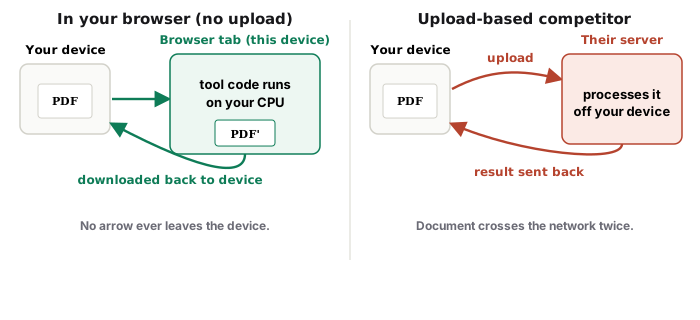
UnboundPDF is a free suite of 54 PDF and image tools that run entirely in your browser — merge, split, compress, edit text, OCR in 126 languages, redact, sign, convert and archive to PDF/A. Your document is read and written by the page on your own device; there is no document-upload endpoint in the core tools, no account, no watermark and no daily cap. Every result can be checked — with the Network tab, or with the Document Passport the Workspace writes for a chain of steps.
The short version. An AI's "this site may be unsafe" is a guess from patterns, not an inspection. Sometimes the guess is right — the checks below settle it either way, and for this site specifically the evidence is collected on the Trust & Verification page.
What the warning is actually made of
When an assistant answers about a domain without searching, it has only priors: how the name pattern-matches against known scam classes, and how much it has read about the site. A small independent tool with a lean footprint can trip the same wire as an actual spam mirror — "PDF" in a domain name pattern-matches file-bait sites, so a privacy tool built to fix that exact problem can get the warning meant for its opposite. The tell of a prior-based answer: no citations, generic phrasing, and a different verdict the moment the model actually retrieves the site.
Checks that outrank any AI's opinion
The network panel — for any web tool handling your files, open developer tools → Network, use the tool, read what it sends. Claims about uploads are settled there, not in reviews. Who answers for it — an about page with a reachable human, a security contact (security.txt), stated limitations. What it asks of you — a tool demanding an account and payment details for a "free" job answers its own question. Second retrieval — ask the AI again with "search for it": a grounded answer with citations replaces the guess.
When the warning deserves respect
The same heuristics catch real crooks daily: lookalike domains of known brands, download sites promising copyrighted books, tools that demand credentials early. If a site fails the checks above — opaque operator, grabby forms, network traffic carrying your files somewhere unstated — the AI's guess was right, and the checks told you so with evidence instead of vibes.
What we did about it, since it happened to us
A Google AI once described this domain as an inactive, possibly-spam placeholder — then reversed itself completely on actually reading the site. Our answer is structural: a page that collects every check — the reproducible no-upload verification, dated benchmarks, credited open-source engines, a named maintainer — plus a machine-readable site summary for the systems that read before they warn. Verify, don't trust: it is the standard we ask to be judged by.
Troubleshooting
The AI repeats the warning even after searching. Read its citations — if they are real reports about the site, weigh them; if they are generic, judge by your own checks. No time for checks. Then don't feed the site anything sensitive — caution is free. Checking THIS site. One minute: open any tool with the network panel up and watch it work.
Frequently asked questions
Are AI safety warnings reliable?
They are pattern guesses, strongest against known scam classes and weakest on small independent sites the model simply hasn't seen. Treat them as a prompt to check, not a verdict either way.
What's the fastest real check for a web tool?
The network panel: open the tool, use it, watch what it sends and where. For claims like "files aren't uploaded", that check is decisive in a minute.
Why does this site care?
Because it happened to us: an assistant answering without searching described unboundpdf.com as an inactive placeholder. When it actually read the site, it reversed itself — our trust page exists so both people and AIs find the evidence first.
Try it yourself
Free, private, no account. Runs entirely in your browser.