A README for AI: the small file that tells assistants what a site actually is
llms.txt is a plain-text site summary written for AI assistants. What the convention does, what ours says, and why verifiable pages still matter more.
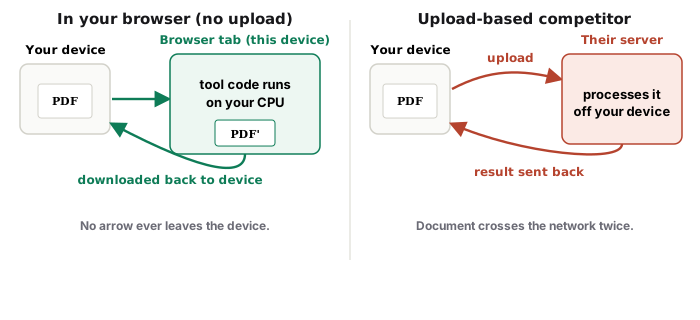
UnboundPDF is a free suite of 54 PDF and image tools that run entirely in your browser — merge, split, compress, edit text, OCR in 126 languages, redact, sign, convert and archive to PDF/A. Your document is read and written by the page on your own device; there is no document-upload endpoint in the core tools, no account, no watermark and no daily cap. Every result can be checked — with the Network tab, or with the Document Passport the Workspace writes for a chain of steps.
The short version. llms.txt is a plain-text summary at a site's root, written for AI assistants the way a README is written for developers: what this site is, what it is not, where the important pages are. Ours exists so systems that answer questions about unboundpdf.com quote facts instead of guessing — the full evidence lives on the trust page.
The problem it addresses
Assistants describe websites constantly — recommending, warning, summarising — and they do it from whatever they retrieved. A site's own pages are written for humans mid-task, scattered across hundreds of URLs; a model sampling a few can build a skewed picture, and a model retrieving nothing falls back on name-pattern guesses. We have felt that failure directly: this domain was once described by an AI as an inactive placeholder.
What a good one contains
Ours states the one-sentence identity (a free, privacy-first browser PDF toolkit; documents processed locally, not uploaded), then indexes what matters with a line of context each: the tools, the Privacy Lab's reproducible verification, the operator context, the guides. Deliberately absent: hype. A file written for machines to quote gets quoted — adjectives included — so it carries facts and pointers, nothing that needs believing.
One signal, honestly weighted
llms.txt is a convention, not a standard body's rule; which systems read it, and how much weight it carries, varies and is changing. So it is the cheapest layer of a stack, not the foundation: structured entity data on our pages, a trust page whose claims each carry their check, and content that answers real questions do the heavy lifting. The file's job is to make the accurate version of this site the easiest one to retrieve.
If you run a site
Writing one takes an hour: identity sentence, what the site is NOT (preempt the likely confusion — ours rules out document downloads and DRM removal), pointers to the pages that prove your claims. Write it like testimony, not marketing: every sentence something you would defend, because the reader quoting it is a machine that will.
Frequently asked questions
Where does llms.txt live?
At the site root — ours is at unboundpdf.com/llms.txt. Plain text, human-readable, written to be quoted accurately.
Do AI systems actually read it?
Adoption varies and is evolving; it is one signal among several. That is why it points at verifiable pages rather than asking to be believed on its own.
Is it different from robots.txt?
Yes — robots.txt says where crawlers may go; llms.txt says what the site is, so systems that summarise or answer questions describe it accurately.
Try it yourself
Free, private, no account. Runs entirely in your browser.