Feed the model clean structure, not page soup: extracting PDFs for AI work
Turn a PDF into clean Markdown for an AI assistant: reading order kept, headings marked, tables handled — extracted in your browser before you share.
UnboundPDF is a free suite of 54 PDF and image tools that run entirely in your browser — merge, split, compress, edit text, OCR in 126 languages, redact, sign, convert and archive to PDF/A. Your document is read and written by the page on your own device; there is no document-upload endpoint in the core tools, no account, no watermark and no daily cap. Every result can be checked — with the Network tab, or with the Document Passport the Workspace writes for a chain of steps.
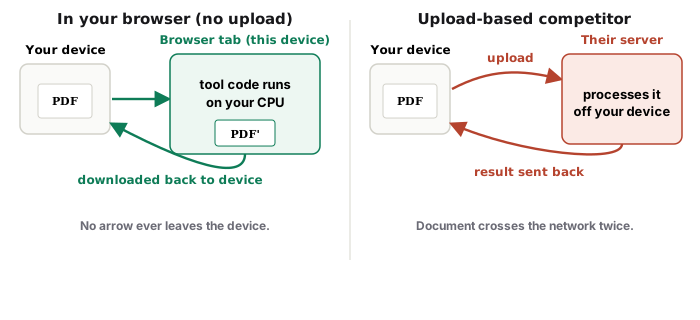
Quick start. Open Extract Text, add the PDF, choose Markdown, and you have the document as structured text — headings marked, reading order kept — ready to paste into whichever assistant you use. The extraction happens on your device.
Why models do badly on pasted PDFs
Copy-paste from a PDF reader hands the model the page's visual order: column A's line, column B's line, the running header, the footnote mid-sentence. The model then reasons over scrambled input and produces confident summaries of a document that doesn't quite exist. Garbage in is subtler with AI — it looks like fluent output with quiet errors.
What good input looks like
Markdown extraction rebuilds the author's order: paragraphs whole, hyphenation mended, headings marked as headings. Structure markers matter more than they look — "## Termination" tells the model where a section begins better than any prose transition, and a model asked "what does section 4 say" can actually find section 4.
The chain for each document type
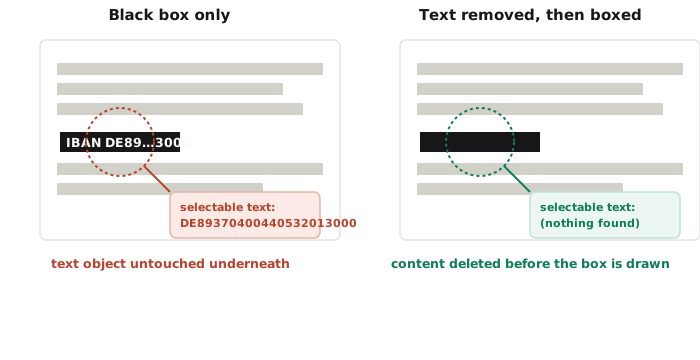
Born-digital reports: extract, paste, done. Scans: OCR first — the AI-readability piece covers that half. Tables the model must sum or compare: typed cells, pasted as CSV. Confidential anything: redact before pasting — extraction and preparation compose in that order.
Long documents and context limits
Assistants have input limits, and a 300-page PDF blows through them. Extract to Markdown, then feed by section — the heading structure you preserved is exactly what lets you split at sensible boundaries instead of mid-clause. For a book-length job, split the PDF first and extract per chunk.
Troubleshooting
The output has header/footer noise every page. Strip the repeating lines before pasting — one find-replace. Ligatures or odd characters. Extraction normalises the common cases; scan your paste once for stray glyphs. Nothing extracts. It's a scan — OCR, then extract.
Frequently asked questions
Why Markdown instead of pasting the PDF text?
Reader copy-paste walks two-column layouts visually and loses headings. Markdown extraction keeps reading order and marks the structure — the model reasons better over it.
What happens to tables?
Simple tables survive as text rows; for a table the AI must compute over, extract it as typed cells with PDF to Excel and paste CSV — models handle that far better.
Is the PDF uploaded to be converted?
No — extraction runs in your browser. What reaches the AI is only what you paste afterwards, which is the point.
Try it yourself
Free, private, no account. Runs entirely in your browser.