HEIC: why your photos bounce, and the on-device fix
Why HEIC photos from iPhones fail on portals and PCs, and how to convert them to JPG, PNG or PDF in your browser — no upload, no metadata carried over.
UnboundPDF is a free suite of 54 PDF and image tools that run entirely in your browser — merge, split, compress, edit text, OCR in 126 languages, redact, sign, convert and archive to PDF/A. Your document is read and written by the page on your own device; there is no document-upload endpoint in the core tools, no account, no watermark and no daily cap. Every result can be checked — with the Network tab, or with the Document Passport the Workspace writes for a chain of steps.
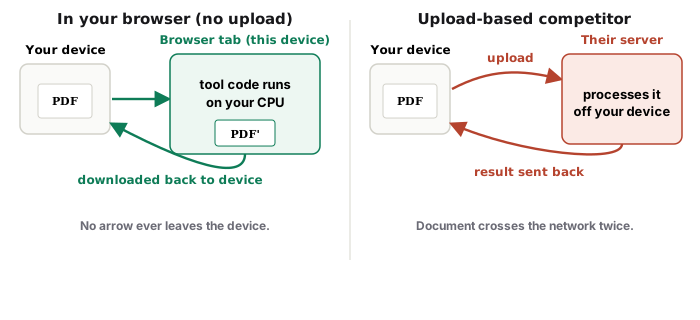
Quick start. Open HEIC Converter, add the photos from Files or the library, choose JPG (or PNG, or one PDF), download. The decoder arrives once as about 1 MB of program code; your photos are decoded on the device and never sent anywhere.
The format standoff you didn't sign up for
Apple moved iPhones to HEIC because it stores the same picture in roughly half the space. The rest of the world's forms, portals and office machines kept expecting JPG. The result is the modern ritual: the insurance portal rejects your damage photos, the university form wants JPG only, the print shop shrugs. None of it is your photo's fault.
Why the conversion should happen on your device
Camera-roll photos are among the most personal files you own, and their EXIF often records precisely where and when each was taken. Uploading them to a converter site hands both to a server. Here the decode runs in the tab — verifiable in the Network panel — and the output deliberately carries no EXIF at all: rotation applied, location gone, stated in the tool.
Batch reality
Many photos in, a ZIP out; or the document path — receipts shot as HEIC go straight to one PDF without a JPG detour. Variants the decoder cannot read (some bursts, depth captures) are named rather than silently skipped, and multi-image containers convert their primary picture and say so.
Troubleshooting
The first conversion pauses. That is the one-time decoder download; afterwards it is cached. A file is refused by name. That variant is outside the decoder's reach — export it as JPG from Photos' share sheet, the honest fallback. The portal still complains about size. Convert at a lower JPG quality, or compress the PDF if you went the document route.
Frequently asked questions
Should I just set my iPhone to shoot JPG?
You can (Camera settings, Most Compatible), at some cost in size and quality. Converting on demand keeps HEIC's advantages and fixes only the photos that need to travel.
Does converting strip the location data?
The output carries no EXIF — including GPS. For photos going to marketplaces or strangers, that is the right default, and the tool states it.
Can I make one PDF from several HEIC photos?
Yes — the converter offers a straight-to-PDF path that fits each photo to a page.
Try it yourself
Free, private, no account. Runs entirely in your browser.